
How a Mystery Trip Carries People’s Intentions Forward
What conversations with our partners reveal about how Japan Ikigai Trip designs travel
Japan Ikigai Trip offers mystery trips where the places are kept off the record, a mystery to everyone but the traveler. Because of this format, mystery trips are sometimes assumed to involve less information or looser planning. Our approach is the opposite. When the places are kept off the record, the structure behind the journey becomes more important. The quality of the experience depends on how carefully context, expectations, and responsibilities are shared among everyone involved.
This page introduces one such journey, an MBA graduation trip to Japan by Marteena, traveling from Canada. Through the words of the partners who supported this trip, we share how Japan Ikigai Trip approaches travel design in practice.
Three partners speak here. The innkeepers of a ryokan passed down through generations for more than a century, in a hot-spring town with 1,400 years of history, where the kaiseki menu changes every month with what is in season locally and ten of the fifteen rooms have their own onsen bath. The Kondo family, blacksmiths since 1872, who for six generations have forged nothing but hoes, shaping the steel the same way swords have long been made, and who now open their forge to people who want to make a frying pan of their own. And Tomoko Steen, the guide and interpreter who accompanied Marteena.
This is not a promotional story. It is a record of how a journey was built.
Although these settings were very different, they shared the same starting point. Before discussing services or logistics, the meaning of the journey was shared. At Japan Ikigai Trip, we begin by understanding a traveler’s background, milestones, and intentions. Only after this context is clear do we decide on destinations, experiences, and daily structure.
“We were given detailed information about the traveler’s background and the purpose of the stay. It was clear that this trip was treated with great care. Since it marked an important life milestone, we felt a strong sense of responsibility.”
“Through the interpreter, we were told that this frying pan would become a companion for Marteena’s new life in Canada. With that in mind, we explained not only the technique, but also how to care for and use it after returning home.”
Before asking a partner to host an experience, the planning team visited the site, experienced the process firsthand, and identified possible points of uncertainty. In Marteena’s case, the workshop was chosen through specific matching based on her questionnaire answers. It was something she could carry into her life after graduation, rather than a one-time activity.
The goal was not to “add something special,” but to ensure the experience fit the traveler as precisely as possible, and that the partner could host it with clarity and confidence.
“To be honest, we were struggling to attract participants to our workshop. We had hoped that someone would come and experience it seriously.”
“Later, we received a detailed proposal document. It covered the flow of the experience and the timing of explanations in great detail.”
“Because we knew the arrival time and schedule in advance, we could prepare luggage handling and guest guidance smoothly. This helped us avoid interrupting the stay.”
Rather than issuing detailed instructions for every scenario, Japan Ikigai Trip shares decision-making principles in advance. This allows partners to act flexibly while maintaining consistency. As a result, travelers are not repeatedly asked to make choices. Their attention stays with the experience itself.
“By handling dinner payments and confirmations, the traveler did not have to worry about small decisions and could relax.”
“Because the workshop duration could vary, we discussed in advance what to do if it ended earlier than expected. This allowed me to make decisions on site without hesitation.”
Photography and video documentation were treated as part of the experience design. At Japan Ikigai Trip, experiences are designed not only for the moment they occur, but also for how they will be remembered afterward.
“We were asked to take over 100 photos and videos, considering that the traveler’s hands would be occupied during the workshop.”
“The most memorable moment was when the frying pan was finished. Seeing the traveler touch it and smile with satisfaction left a strong impression.”
Each trip is reviewed carefully and used to refine future journeys. The conversation with our partners does not end when the trip does.
A mystery trip at Japan Ikigai Trip is never created by one party alone. It is shaped through close collaboration with trusted partners, clear communication of context, and shared responsibility at every stage.
This page serves as an official record of how such journeys are created.
Keep reading
See a whole trip, day by day
These conversations show how one trip was prepared. Follow another journey from the traveler’s side.
Example trip
“A Trip of a Lifetime”
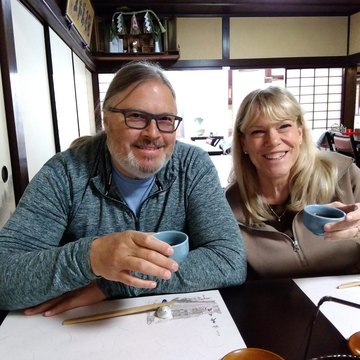
A couple from the United States spent fifteen days moving slowly westward through hot-spring mountains, a canal town and shrine country, with a birthday on the water in the middle.
View the example trip →